


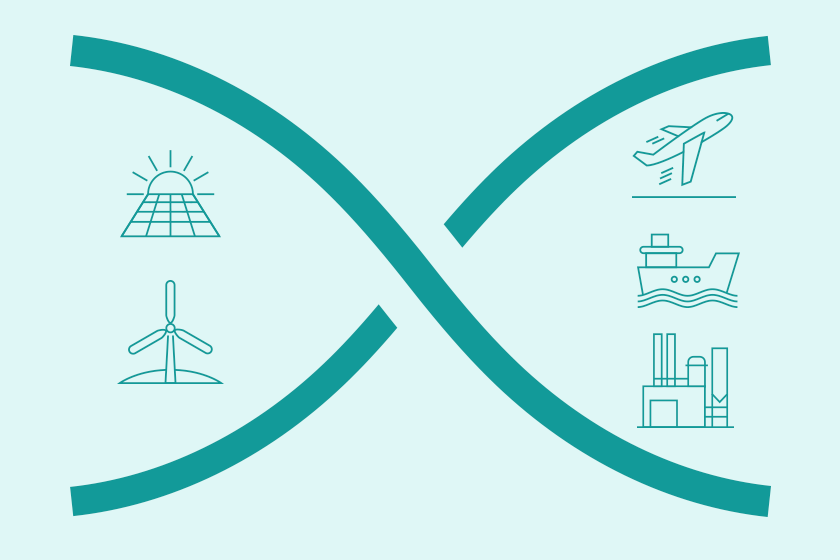
Power-to-X (P2X) describes a family of technologies that convert renewable electricity into fuels, chemical feedstocks, and other energy carriers. These pathways use green hydrogen as a central building block. When combined with captured carbon dioxide or nitrogen, green hydrogen serves as a basis for synthetic e-fuels such as e-methane, e-methanol, e-ammonia, and e-kerosene.
P2X is not a single technology. It is a system approach that links renewable power, hydrogen production, carbon capture, and fuel synthesis into integrated value chains [1].
This article explains how P2X works, why green hydrogen is essential, which e-fuels are most relevant, and how policy and economics will shape deployment in hard-to-abate sectors.
1. The Power-to-X framework
P2X starts with renewable electricity from solar, wind, or hydropower. This electricity is used to produce hydrogen by splitting water. The hydrogen then feeds different synthesis routes that produce gases, liquids, and chemicals [1][2].
The “X” in P2X usually refers to:
- Power-to-hydrogen. Renewable electricity is used to electrolyse water to produce hydrogen gas.
- Power-to-gas. Hydrogen combined with carbon dioxide to produce synthetic methane.
- Power-to-liquid. Hydrogen and carbon dioxide are used to produce liquid fuels such as methanol, kerosene, or diesel.
- Power-to-chemicals. Hydrogen is used as a feedstock to produce ammonia and other chemicals [1][2].
P2X has three leading system roles.
First, it turns variable renewable power into storable chemical energy. Chemical carriers such as hydrogen, ammonia, or synthetic hydrocarbons can be stored in tanks or underground caverns and transported over long distances [1].
Second, it supports grid balancing. Electrolysers can operate flexibly and absorb excess renewable electricity during periods of low demand, thereby reducing curtailment and improving overall system utilisation [2].
Third, it enables sector coupling. P2X connects the electricity system with sectors that are hard to electrify directly, such as aviation, shipping, and energy-intensive industry [1]. In these sectors, liquid or gaseous fuels remain essential due to energy density, process requirements, or asset lifetimes.
2. From hydrogen to e-fuels. Key pathways
Once green hydrogen is available, it can be combined with carbon dioxide to produce e-fuels. Each pathway has specific chemistry, infrastructure implications, and market applications.
2.1 E-methane. A drop-in gas for existing networks
E-methane is produced through the Sabatier reaction, where hydrogen reacts with carbon dioxide over a nickel catalyst to form methane and water [6]. The resulting fuel has properties nearly identical to those of fossil natural gas.
The main advantage of e-methane is its compatibility with existing infrastructure. It can be blended into or fully replace fossil gas in existing gas grids, underground storage, LNG terminals, and gas-fired power plants with minimal technical changes [6]. This makes it attractive for regions with extensive gas networks and storage assets.
However, e-methane still contains carbon. It relies on sustainable carbon dioxide sourcing to deliver climate benefits and remains most relevant where there is significant existing gas demand and infrastructure.
2.2 E-methanol. A liquid fuel for shipping and chemicals
E-methanol is produced by reacting green hydrogen with captured carbon dioxide in a methanol synthesis loop [7]. The process uses copper-based catalysts that are optimised to handle high water content and maintain selectivity [8].
Methanol is a liquid at ambient temperature and pressure. This simplifies handling, storage, and transport compared with gaseous hydrogen. Green methanol is gaining attention as a marine fuel because tank technologies and safety protocols are already well established in the chemical industry [7]. It also serves as a platform chemical for a wide range of products.
The main challenge is that e-methanol is a hydrocarbon, so it releases carbon dioxide at the point of use. However, in Power-to-Methanol systems, this carbon originates from an existing industrial source, which means the process recycles CO₂ that has already been emitted rather than adding new fossil carbon to the atmosphere. Climate benefits depend on sourcing carbon dioxide from biogenic or atmospheric streams and ensuring a closed carbon loop across the lifecycle.
23. E-ammonia. A carbon-free energy carrier
Ammonia is produced via the Haber-Bosch process, which reacts hydrogen with nitrogen at high temperature and pressure [9]. In its conventional form, the hydrogen comes from fossil fuels. In e-ammonia, hydrogen is replaced with green hydrogen, and process energy is supplied by renewables [9].
E-ammonia contains no carbon and emits no carbon dioxide at the point of use. This makes it a promising candidate for deep-sea shipping and for transporting hydrogen over long distances. It can be shipped as a liquid under moderate pressure and then either combusted in adapted engines or cracked back to hydrogen at the destination [9].
Key hurdles include toxicity, handling risks, and the formation of nitrogen oxides during combustion. Engine concepts and fuel cell systems that use ammonia indirectly via cracking are under active development.
2.4 E-kerosene and e-diesel. Drop-in fuels for aviation and heavy transport
Long-chain hydrocarbons, such as e-kerosene and e-diesel, are produced via Fischer-Tropsch (FT) synthesis. This process converts a mixture of carbon monoxide and hydrogen (“syngas”) into synthetic crude, which is then refined [10].
Because captured carbon dioxide cannot be used directly in FT synthesis, it must first be converted into carbon monoxide. This happens either through the reverse water-gas shift reaction or via high-temperature co-electrolysis in a solid oxide electrolyser [4][10]. The resulting syngas is fed into an FT reactor with iron or cobalt catalysts to produce a spectrum of hydrocarbons.
After upgrading and refining, e-kerosene and e-diesel are chemically indistinguishable from their fossil equivalents [11]. They can be used in existing aircraft and heavy-duty engines and can flow through existing pipelines and terminals. This drop-in character is the main reason why e-kerosene is considered the leading long-term solution for decarbonising long-haul aviation [11].
3. Carbon dioxide sourcing and regulation
Most e-fuels require a sustainable carbon dioxide feedstock. The climate value of an e-fuel depends on where the carbon it emits comes from and how it is accounted for.
3.1 Point-source and atmospheric carbon
Industrial point sources such as cement kilns, fertiliser plants, and biogas upgrading facilities emit concentrated carbon dioxide streams. Capturing from these sources is relatively cost-effective because concentrations are much higher than in ambient air [49].
A key distinction is between:
- Fossil point sources, where carbon originates from coal, oil, or gas. Using this carbon in e-fuels recycles it once, but does not make it carbon-neutral over the whole cycle.
- Biogenic point sources, such as biomass power plants or biogas facilities. Here, the carbon was recently taken from the atmosphere by plants. Reusing this carbon in e-fuels can create a closed carbon loop when managed sustainably.
Direct air capture (DAC) removes carbon dioxide directly from ambient air. This guarantees atmospheric carbon removal but at much higher energy and cost, due to the low concentration of carbon dioxide in the air [50][51]. DAC can be co-located with significant renewable energy resources, reducing the need for long carbon dioxide pipelines.
4. Hard-to-abate sectors and priority use-cases
E-fuels are energy-intensive and costly to produce. Studies show that hydrogen-based e-fuels deliver overall electricity-to-motion efficiencies of around 10–35 per cent once all conversion and combustion losses are considered [15]. Battery electric vehicles are several times more efficient when direct electrification is possible [15].
For this reason, e-fuels are not a long-term solution for mainstream road transport. Their strategic role lies in sectors where no viable alternatives exist at scale.
4.1 Aviation
Aviation is the most precise “no-regret” application for e-fuels. Long-haul aircraft require very high energy density. Battery technologies cannot meet this requirement within acceptable weight and volume limits.
E-kerosene produced via P2X is a drop-in fuel that can be blended with fossil kerosene in existing aircraft and infrastructure [11]. Today, most sustainable aviation fuel (SAF) is bio-based, produced from waste oils and fats. However, these feedstocks are limited and cannot meet global aviation demand without land-use conflicts [14].
E-SAF solves this constraint by using renewable electricity and captured carbon dioxide as feedstocks. These are not limited in the same way, so in principle, e-SAF can scale with global renewable deployment [14]. The challenge is cost. E-kerosene is currently much more expensive than fossil jet fuel.
The EU’s ReFuelEU Aviation regulation addresses this by setting SAF mandates and a dedicated sub-quota for synthetic fuels. The synthetic share starts at 1.2 per cent in 2030 and rises to 35 per cent by 2050 [13]. This creates a guaranteed market for e-kerosene and gives investors a long-term demand signal.
4.2 Maritime shipping
Deep-sea shipping relies on heavy fuel oil and has long vessel lifetimes. Batteries are feasible only for short distances and small vessels. For long routes, e-methanol and e-ammonia are the two leading candidates.
E-methanol offers easier handling and more mature engine technology. E-ammonia offers zero carbon at the point of use but faces safety and NOx challenges [9]. Many shipowners are hedging by ordering dual-fuel vessels and watching how the fuel ecosystem develops.
For both fuels, e-fuel routes compete with bio-based options and with other decarbonisation measures such as wind assistance and slow steaming. P2X adoption in shipping will depend on fuel availability at key ports, global regulations, and the evolution of engine technology.
5. Outlook
Power-to-X and green hydrogen e-fuels will not replace direct electrification. They complement it. Their role is to decarbonise sectors that cannot run on electrons alone and to provide energy-dense, globally traded fuels in a net-zero system.
In the coming decade, progress is likely to concentrate in a limited number of flagship hubs with excellent renewable resources, strong policy support, and access to sustainable carbon dioxide. Aviation and maritime shipping will remain the priority markets. Costs should fall as projects scale, but e-fuels are expected to stay premium products.
For energy system planners, the key is to use e-fuels where they deliver the highest climate value per kilowatt-hour of renewable electricity and per euro invested. When framed this way, P2X is not a universal solution but a focused tool for enabling a credible and realistic pathway to net-zero.
References
- Power-to-X: paving the way for a greener future - Ramboll, accessed on November 18, 2025, https://www.ramboll.com/net-zero-explorers/power-to-x-explained
- Power-to-X - Wikipedia, accessed on November 18, 2025, https://en.wikipedia.org/wiki/Power-to-X
- The Colors of Hydrogen | The Belfer Center for Science and International Affairs, accessed on November 18, 2025, https://www.belfercenter.org/research-analysis/colors-hydrogen
- Hydrogen Production: Electrolysis | Department of Energy, accessed on November 18, 2025, https://www.energy.gov/eere/fuelcells/hydrogen-production-electrolysis
- Your guide to electrolysis: the tech behind the green hydrogen revolution - Topsoe, accessed on November 18, 2025, https://www.topsoe.com/blog/your-guide-to-electrolysis
- E-methane's potential role in reducing emissions explained | Spectra by MHI, accessed on November 18, 2025, https://spectra.mhi.com/e-methanes-potential-role-in-reducing-emissions-explained
- Green methanol: the fuel to accelerate shipping's energy transition - Iberdrola, accessed on November 18, 2025, https://www.iberdrola.com/about-us/what-we-do/green-hydrogen/green-methanol
- Green Methanol Production| eMethanol Plant Solutions ... - Topsoe, accessed on November 18, 2025, https://www.topsoe.com/solutions/outputs/methanol/emethanol
- Ammonia: zero-carbon fertiliser, fuel and energy store - Royal Society, accessed on November 18, 2025, https://royalsociety.org/news-resources/projects/low-carbon-energy-programme/green-ammonia/
- 10.2. Fischer-Tropsch Synthesis | netl.doe.gov, accessed on November 18, 2025, https://www.netl.doe.gov/research/carbon-management/energy-systems/gasification/gasifipedia/ftsynthesis
- Current and future cost of e-kerosene in the United States and Europe, accessed on November 18, 2025, https://theicct.org/wp-content/uploads/2022/02/fuels-us-europe-current-future-cost-ekerosene-us-europe-mar22.pdf
- EU REQUIREMENTS FOR RENEWABLE HYDROGEN AND ITS DERIVATIVES - PtX Hub, accessed on November 18, 2025, https://ptx-hub.org/wp-content/uploads/2023/04/International-PtX-Hub_EU-Requirements-for-green-hydrogen-and-PtX.pdf
- Aviation - eFuel Alliance, accessed on November 18, 2025, https://www.efuel-alliance.eu/political-demands/aviation
- e-SAF offers much promise within Sustainable Aviation Fuels - Topsoe, accessed on November 18, 2025, https://www.topsoe.com/blog/e-saf-offers-much-promise-in-sustainable-aviation-fuels
- Potential and risks of hydrogen-based e- fuels in climate change ..., accessed on November 18, 2025, https://publications.pik-potsdam.de/rest/items/item_25599_7/component/file_26999/content
- E-fuels: a techno-economic assessment of European ... - Concawe, accessed on November 18, 2025, https://www.concawe.eu/wp-content/uploads/Article-2-E-fuels.pdf
- 7 Things to Know About Carbon Capture, Utilization and Sequestration, accessed on November 18, 2025, https://www.wri.org/insights/carbon-capture-technology
- Clean Hydrogen Production Tax Credit (45V) Resources | Department of Energy, accessed on November 18, 2025, https://www.energy.gov/articles/clean-hydrogen-production-tax-credit-45v-resources
- Renewable transport – Renewables 2025 – Analysis - IEA, accessed on November 18, 2025, https://www.iea.org/reports/renewables-2025/renewable-transport
